


A recently published editorial in Nature strongly advocated for more stringent research protocols to protect the rights of invertebrate animals like squids and octopuses used in scientific studies.
(Octopi is the Latin ending. Octopuses is the English ending. Same applies to cacti, syllabi, nuclei. Take your pick, both are right.)
While invertebrate animals are used to study things like camouflage and microbial interactions, they’re generally hard to come by in life science research. Mice, rats, pigs, and chimpanzees are more commonly used for their similarity (or sometimes dissimilarity) to human anatomy. These are in vivo studies, which directly translates to “in life.” Different animal models provide a range of advantages and disadvantages in their care requirements, cost, and relevance to humans. And in some cases, I’d argue that human subjects research are “models” meant to loosely represent the broader population.
Animal models aren’t the only option in life science research, though! In vitro (literally “in glass”) models are less complex systems that we can still use to study individual cells or small groups of cells and their reactions to different stimuli. More recently, in silico (“in silicon”) models have been used to computationally predict specific outcomes in different organisms, which omits the need for real life models almost entirely. Animal models are often highlighted in media as being subject to violence and cruelty. Some consumers might specifically shop for cruelty-free cosmetics and household goods, but as of 2026, these terms have no legal definition in the United States. On the surface, using animals in research does sound cruel. Here, we’ll discuss more about the protocols already in place for protecting animal in research, and some ethical perspectives on what it means to choose the “right” animal for a specific study.
Let Yourself Engage With a Nuanced Point
It seems easy for this discussion to head towards something like “where do we draw the line?” But that isn’t what should motivate a researcher’s choice of model. There are no models that are “on” or “off” the table when designing a study. Until the budget, length of study, and research question have been established, you could hypothetically use any organism (or less than an organism. A mixture of chemicals with no life could still be an in vitro model depending on who you ask.)
But as more and more about the project becomes more and more defined, the choices quickly narrow. Is this a mechanistic study, or a black-box approach? Is the length scale minutes, hours, days, or years? Is the goal to generate a preliminary finding to support an upcoming grant proposal, or make strong progress towards commercialization and adoption of a new intervention?
Chemical Model
The simplest system to work in for life sciences is a chemical model. Here, you might study an interaction between two molecules, the rate of transfer across a barrier, or another reaction that doesn’t require live organisms to study. This is typically where we have the most “mechanistic” insight, i.e. we can determine exactly what is going on, where, and how (given sufficient experimental design). It’s also the most convenient to perform, and typically the fastest.
Cell Model
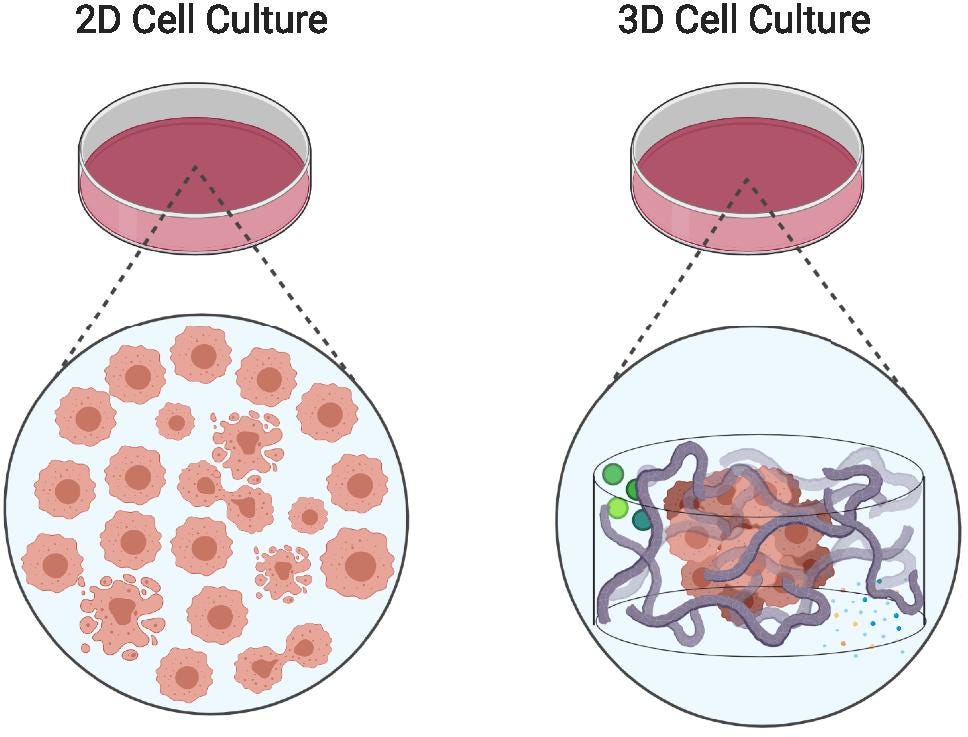
A step above a chemical model is a cell model. In this system, cells are grown in single layers in a laboratory setting and treated with something to assess some response. Traditionally, this is known as 2D cell culture, because the cells will assemble as one continuous layer across the bottom of a plastic Petri dish. This is usually a single cell type grown under a very specified set of conditions. Similar to a chemical model, cell models are also highly controllable and inexpensive in the life sciences. These are traditionally known as in vitro models, though some people also refer to chemical models as in vitro.
Organs and Organoids
Though, the highly simplified system of a cell model doesn’t account for the 3D organization of cells in real tissues. If you wanted to understand more about the spatial organization of cells in a 3D tissue, you would transition to spheroid or organoid cultures. These are popular in disciplines focused on specific organs (e.g. brain, lung) that have complex structures. Things can get tricky here because 3D cell cultures are very vulnerable to nutrient depletion, and analysis techniques used in 2D culture often need some modifications for 3D culture systems. For example, in 2D culture, all of the cells have pretty much equal access to sugar, nitrogen, micronutrients, and oxygen. In a 3D spheroid culture, the cells buried in the center of the tissue have a more difficult time accessing nutrients compared to the cells positioned at the surface.
These types of models—chemical, cell, and organ—typically don’t receive much media scrutiny as these tissues aren’t canonically “sentient.” While these systems do respond to actively respond to their surroundings, they don’t possess the same amount of consciousness compared to that of a rat or a mouse that might raise some eyebrows from people interested in protecting animal rights.
Rats, Mice, and Invertebrates
But at some point, just looking at tiny cells isn’t enough information. It becomes necessary to study an organism with a full anatomy. The “simplest” animal models (these organisms are by no means simple, they are moreso thought of this way because they are easy to manipulate) are typically flies, rats, and mice. Sometimes zebrafish are thought of in this category too, but these are usually used for more niche systems like limb regeneration.
These organisms have the benefit of 1) historical precedence 2) relative cost to rear and 3) size. Flies, mice, and rats have been used for so long that there are highly detailed, highly repeatable instructions on how to raise and study them. For the case of mice, there are strains of mice that have been inbred (purposely) for many decades to produce a population of nearly genetically identical organisms. This is an important advantage over a collection of genetically-diverse mice to use for a study because genetics can change the outcomes of a study a LOT even if you don’t mean for it to!
Even if these are relatively cheap animals to raise, that doesn’t make them cheap. Whereas you might keep a 2D cell culture alive for days to weeks, mice can take 6-8 weeks to progress to adulthood and live for 2-3 years. There’s often a flat rate to purchase the mouse, daily food and water, and a per diem for mice to be housed. Usually mice and rat studies are cited in the news for testing of pharmaceuticals, specific food ingredients, or psychological phenomena.
To even consider doing research using animal models, the National Institute of Health requires adherence to strict policies designed to protect the rights of animals as much as possible. Researchers are required to submit a full report on what animals, how many animals, what they will be subject to, and what knowledge will be gained before the project can begin. These reports are reviewed very closely by the Institutional Animal Care and Use Committee (IACUC), which every American institution is required to have if they engage in federally-funded animal vertebrate model research (recall, the Nature editorial calling for more stringent protection of invertebrates). Once the study is over and published, the authors are also required to disclose exactly what protocols they followed when raising and studying the animals (these generally vary by country, which is why it’s necessary to disclose which protocol was used).
Pigs
But mice and rats are not close approximations of people. What we observe in a mouse might not translate to humans for a number of reasons, which creates a difficult choice for many life science researchers. When mice, rats, and other little critters aren’t representative enough of people, it often makes sense to study pigs and other mammals (An alternative reason is if your research question is specific to pigs or some other large animal.). Pigs are generally smarter, and they are more similar to humans in terms of their genetics, anatomy, and metabolism. For example, this study examined how well a lab-simulated model of the intestine matched the mechanics of a pig intestine, as a proxy for human anatomy (In this case, we have a chemical model approximating an animal model, and the animal model was previously used to approximate what happens in a human. It’s models all the way down).
Apes & Monkeys
And in some cases, even the pig as an animal to represent a human isn’t close enough. Chimpanzees are the most common animal model used in vaccine and infectious disease research to most closely replicate a human’s response to a virus. Proposing to do research on animals that are regarded as generally highly intelligent (pigs, chimpanzees) generally means the study will be under even more scrutiny. These trials are expensive, risky (to both animal and human scientist), and are simply not necessary for the majority of life science research. Even chimpanzee studies are quite rare now.
People!
And at the top of the animal model chain, we arrive at human clinical trials. These are the ultimate “approximation” of YOU that you will ever find in a study. And even clinical trials are not always applicable to the entire human population. Treatment effects can differ between sexes, diets, exercise levels, professions, ages, and every other demographic I don’t have time to name. Analogous to IACUC, any academic study involving humans will require approval from the Institutional Review Board (IRB) at a university. IRB approval is not reserved for just medical-type studies either; sometimes you need to study humans because only a human could articulate to you what the texture of a food is, or whether a pointy polygon is Kiki and a rounded one is Bouba.

I was once taught about how the American government places guards between animal models and the American people to ensure we don’t end up ingesting even close to the lethal dose of aspartame from Diet Coke (or another compound). I was taught this using two important sentiments:
Mice aren’t people (in the case of a mouse study).
People aren’t people (you and I are different, and we are also different from David Bowie).
For example, the U.S. Acceptable Daily Intake (ADI) of a compound is calculated first by assessing the dose at which no harmful effects are observed in a mouse (called the NOAEL), and dividing by 10 (mice aren’t people), and dividing by 10 again (people aren’t people). This essentially means that for a reasonable person (a bold assumption), you will be limited to ingesting 100 times less what a mouse would ingest, and that mouse would STILL not observe a harmful effect in a study.
In vino veritas
So, deciding which animal model to use is not always a question of what animals are “allowable” for experimentation, but rather which animal model will maximize the knowledge gained and minimize the cost (time, money, and wellbeing). In this decision, we also collectively acknowledge that certain organisms are more difficult to control, rear, and study, which often shortcuts to “certain organisms hold more value than others.” But engaging in ethical animal model research is not mutually exclusive from having respect from living things. And in each different model, starting from chemical all the to chimpanzee, there is some truth to be learned about some in vitro or in vivo system, just as in vino veritas, or “in wine, there is truth.”
Great post! This part:
“In this case, we have a chemical model approximating an animal model, and the animal model was previously used to approximate what happens in a human. It’s models all the way down”
is right on! I think we see this kind of thing commonly in systems where direct observations are difficult. It’s hard to see exactly what the fluid flow looks like inside an intestine in a living creature, so in that case researchers made a mathematical model of a physical device that itself is a model of a pig which is a model of a human. It truly is a system of nested models. I think a part of “the trenches” of science is studying/characterizing models themselves and building new ones. That’s not always glamorous or high impact work but it can be rewarding as well.