


Welcome to my new series, Tipping Point, a subsection of Biotech Trash Talk dedicated to exploring ethical challenges in science and engineering.
A slight deviation from my alt protein timeline series, this week we’re taking a look at the authorship dilemma, which is the challenge of determining who should be listed as an author on a peer-reviewed publication and in what order. Disclaimer: this post raises more questions than answers.
Publishing
At the very top of a peer-reviewed journal article, you’ll find the article title, journal, date of publication, and the contributing authors. Years ago, it was typical that most research articles, textbooks, and other academic works had only one or two authors. If the article was part of a graduate student’s thesis, the student is typically listed first and then the advisor or mentor. All in all, the first author is credited with the bulk of the work. My peers often distinguish their publications by first- or co-author status, signifying they have more ownership and involvement in those projects

But what happens when you have five, ten, or a dozen contributing authors? Who is permitted to be credited with the work? Who deserves the title of “first author?”
…Nobody Knows
There are no standardized guidelines for first authorship or authorship order. This is a growing problem in the publishing world, especially as scientists are encouraged to collaborate on larger and larger projects. One idea is to simply list authors alphabetically, removing the ownership component entirely; each author is perceived as having equal importance. However, not every author contributes “equally” to a project. It’s a little too idealistic to expect equal contribution.
Another common strategy is to list authors in order of contribution level, from greatest to least, except the advisor or mentor is listed last (confusingly, I’ll admit). So, a paper with four authors might follow the formula:
Most contributing author, next most contributing author, least contributing author, The Boss™.

It’s not that authorship is a question of seniority, though often the authors that “came up with the idea” are more senior and removed from the mundane tasks (like data collection), which are often assigned to graduate students and undergraduate researchers. Graduate students arguably bear the most responsibility of these parties. (Aside—this is a contentious area in research. Graduate students perform most of the science, but professors and advisors are often credited the most with the work, which creates a lot of tension. Students are seen as students, but really they’re employees, which academic institutions use as an excuse to keep stipends and benefits low but research outputs high.)
The more authors you add, the more confusing authorship and credit become. A more recent requirement in some journals is to disclose what each author specifically contributed since, interestingly, being listed as an author doesn’t necessarily mean you wrote the paper. Typical contributions are: study conception, study design, data collection, figure design, data analysis, manuscript writing, and manuscript editing or reviewing.
But even this disclosure raises a new issue: what is the perceived value of each task, and should that value dictate authorship credit? Should the person who collected the data be listed first, since our interpretations are ultimately based on their work? Should the person who analyzed the bulk of the data be listed first because this work constitutes the highest intellectual skill? Should the main writer of the manuscript be listed first simply because we’re reading their work at this very moment?
I can definitively say as a graduate student, papers resulting from my thesis will be published with me listed as the first author. That’s an easy distinction because my degree is contingent upon developing skills in study conceptualization, experiment design, data collection, data analysis, and scientific writing. It makes sense that graduate students are first authors on their own projects.
Who is the second, third, or fourth author, if that many people contribute to my paper? Of course, I’ll include my advisor as the conventional last author. But what about undergraduate students who help with data collection or other graduate students with relevant expertise that I consulted significantly throughout the project? If I was co-advised, in what order would I list my advisors?
To complicate it even further, many papers have an Acknowledgements section at the end, commonly used to list funding agencies or institutions that donated samples or equipment.
Let’s say I needed to be trained on microscopy to pursue my project, and I consulted my institution’s (imaginary) Center for Microscopy. If a staffer at this center trained me on a microscope, and then I published data using that training and that microscope, what credit does the staffer deserve? I would argue the Acknowledgements section is the appropriate distinction for these peripheral parties that help in the scientific process, but at what point is someone “promoted” from Acknowledgements to author? Even a step below Acknowledgements is to be cited in the References. All of these sections of a paper—authors, Acknowledgements, and References—are sections that award respect, but in differing capacities.
Some institutions have written explicit guidelines for determining authorship, like the International Committee of Medical Journal Editors, which defines authorship criteria as:
Substantial contributions to the conception or design of the work; or the acquisition, analysis, or interpretation of data for the work; AND
Drafting the work or reviewing it critically for important intellectual content; AND
Final approval of the version to be published; AND
Agreement to be accountable for all aspects of the work in ensuring that questions related to the accuracy or integrity of any part of the work are appropriately investigated and resolved.
Notice the comparative and non-specific language in these guidelines, like “substantial” and “reviewing.” Are authors required to be part of the writing of the whole manuscript, or just the bits and pieces they worked on? These criteria don’t provide clear answers. Even “interpretation of data” is listed as a good-enough reason to be listed as an author. What if I brought my data to one of my committee members in an effort to parse out my findings? Does that make them an author?
I called my partner while drafting this post for advice—should I list him as an author?
Gifts & Ghosts

On the flip side, sometimes people are included as authors without actually contributing anything to the project, an unethical practice known as gift authorship. Gift authorship is often granted as a result of social pressures or extreme (nearing unnecessary) respect for a researcher.
Interestingly, the opposite concept is also an issue in authorship and publishing: ghostwriting. Ghostwriting is when the person who wrote the work is not listed as an author. In book publishing, dedicated ghostwriters, especially in fiction, are still paid for their work, but their name isn’t listed on the final product. They still receive compensation.
Ghostwriting in academia, on the other hand, is a little fishier. As academics, we collectively agree to preserve academic integrity, which includes the agreement to not steal or plagiarize intellectual works. Explicitly listed authors on ghostwritten papers may not be fulfilling their obligation to foster a community with strong academic integrity. And, in many cases, the ghostwriter on a peer-reviewed publication may be from an institution in the private sector with obvious competing financial interests, which compromises the integrity of the published work. Both parties lose.
A World Record
The current record-holder for most contributing authors on a peer-reviewed journal article is a publication in Physical Review Letters, with over 5,000 authors. Five. Thousand. Somehow the actual paper is only 9 pages, with the following 24 pages used just to list the authors.
(If you’re an academic, I know what you’re thinking—is PRL a respected journal? PRL is regarded as the most prestigious journal in the field of physics.)
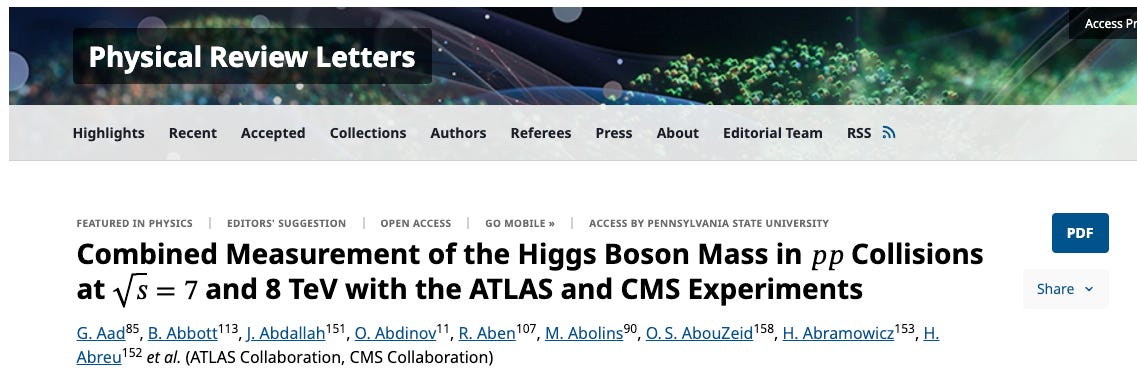
What does it even mean to be part of a 5,000-author collaboration? Or, perhaps more importantly, what does it mean to first-author a 5,000-author paper (I use first-author as a verb because this issue is so pervasive.)? That might be the ultimate scientific feat—our physicist friend G. Aad takes home the biggest authorship prize ever awarded. Even the eight authors listed after G. Aad take home a big win here—how did they decide that these eight would be listed at the beginning of the article?
My Internal Conflict
In my undergraduate, I had an independent research project in chemical engineering that I would say was comparable in complexity and intensity to at least an M.S.-level project (and maybe even PhD). When I say independent, I mean I wasn’t paired with a graduate student. In many research labs, undergraduate students work directly with graduate students on the same project, but that wasn’t true for me. At the beginning it was by chance; my advisors hadn’t recruited for my project yet, and then things ended up changing. But I took the opportunity and ran with it.
Because I was the only student on the project, I was in charge of its direction, which I thoroughly enjoyed. I had the freedom to ask the research questions that I cared about answering. I had the autonomy to identify the right methods and data visualization techniques to tell this scientific story. I loved having this level of control over my project.
On the other hand, my project being mine meant that I was also solely responsible for writing a manuscript that would result from my experiments. It was my job to report what I had done, and my advisors would be there to read and review my manuscript when I had written it.
I never wrote the paper. In my head, I had a million reasons for not writing it—I was taking seven classes and had no time, I needed to repeat an experiment, I didn’t have enough data, I didn’t know how to interpret my data, whatever. The reality is, people have published papers on less information than I had from my project. I could have managed it.
I have peers that have published in their time as undergraduate researchers. Publishing is a major milestone on a project, and people should celebrate when their papers are accepted. But to be frank, some people are just in the right place at the right time, and they are lucky enough to get listed as an author (though maybe not a first author).
I felt cheated. I felt cheated that my project was regarded as being high-quality, highly innovative, yet I didn’t get the same recognition. I’ve presented this work a half dozen times, and every time people ask where they can find my papers. Professors have even nominated me for internationally-competitive scholarships for early-career, high achieving scientists thinking I’m published. People are genuinely surprised that I don’t have papers.
And this is what I didn’t know about science when I started: you have to stop at some point to report what you did, or no one will know. You have to tell someone that you learned something new so they can learn it, too! You have a duty as a scientist to report what you’ve found.
That’s where I failed—I didn’t even know I had this obligation. I just thought that, at some point, the work will get published when I’m finished with it—but you’re never finished with it. When grad students graduate, 90% of the time their project is handed off to the next student, who asks some new questions and generates some new data, only for the cycle to repeat. (Even my undergraduate project has morphed into a graduate-level project now for a new student. Maybe I should just take that as a win.) There is no concrete end to the project, but you have to work in the time to publish or you’ll end up like me, with all of the effort expended and none of the credit.
So, a toast to gifts & ghosts, the over-recognized and under-recognized. Being a published author is great, but it isn’t everything, and sometimes it isn’t even anything (if you’re a gift author).
Great blog you have going Josie! :)