


As with many new technologies, consumer adoption of and willingness to accept alternative proteins has been a stop-start journey. Excitement and anticipation are high at the first proof-of-concept products, but then consumers seem to turn away or return to proteins in their comfort zones.
To help bridge the gap in knowledge, specifically how these products are manufactured compared to conventionally farmed proteins, many experts try to give examples in parallel industries. For food and energy industries, common analogies have been the transition from gas-powered to electric vehicles, digital photography in place of film, incandescent lightbulbs changed to LEDs, and a number of other narratives. Of course, none of these actually teach the consumer what an alternative protein is, but they can be a helpful tool used to illustrate how necessary a technological transition can be.
Today, Trash Talkers, we discuss a new analogy that I have not seen used before: lab-grown diamonds and cultured pearls.
Old Habits Die Hard
In my experience, the hardest part of adopting a new technology is letting go of the old one. Consumers feel exceptionally attached to their choice foods and food types. We use favorite foods as icebreakers. Most holidays involve a consistent meal year to year. We have label terms for what foods we eat, and they often become a critical anchor of our identities: omnivores, vegetarians, vegans, pescatarians. Religious acts also revolve around food: Christian communion, ancient Greek libations, kosher meals, fasting. We celebrate wins and lessen the pain of losses with our favorite foods.
These habits and values are thousands of years old because they were born from instinct. Food is social for us because it benefited our ancestors to eat together for protection. What started as necessity has become an incredible privilege and often an act of love. So, when products like cultivated meat, fungal mycoprotein, and plant-based burgers threaten our food values, our natural reaction is to resist. I do it, too even though 50% of my life is spent thinking about and researching alternative protein technologies.
What will drive consumers to change their attitudes?
What Do We Hate About “Lab-Grown?”
To go back to our “parallel industries” discussion, I see interesting overlap between alternative proteins and jewelry. Lab-grown diamonds and other gems are becoming more and more popular for their cost affordability, increased quality, and sourcing. These products look and function identically to their mined counterparts because they appear and function identically. They do the job. However, some consumers continue to resist lab-grown diamonds, labelling them as “fake.” People continue to want the “real thing” even though the alternative they are presented with can play the exact same role.
I recently learned that the vast majority of pearls bought and sold today are cultured, with some estimates reaching as high as 95%. If you have real pearls and your name isn’t Queen Elizabeth, they are almost guaranteed to have been made with human intervention. Significant intervention. In fact, we’ve been culturing pearls on a commercial scale for nearly 100 years.
Pearls form when a mollusk experiences tissue damage. To heal the damage, the organism will secrete a chemical that forms a cyst, which later becomes the pearl. But relying on chance to meet the massive demand for high quality pearls is too risky. To culture pearls, a tissue graft is inserted into the mollusk from a donor mollusk to kickstart pearl formation. The resulting pearl is functionally the same. You can even control the shape of the pearl by manipulating the shape of the tissue graft:

Consumers don’t seem to care whether their pearls were made via culturing. But for diamonds, the conversation for some people becomes more complicated; lab-grown and mined diamonds do not hold the same value for every consumer.
The difference is in perception, not in substance. Cultured pearls and accidentally-formed pearls function exactly the same way. Lab-grown diamonds and mined diamonds function exactly the same. They both look great on you.
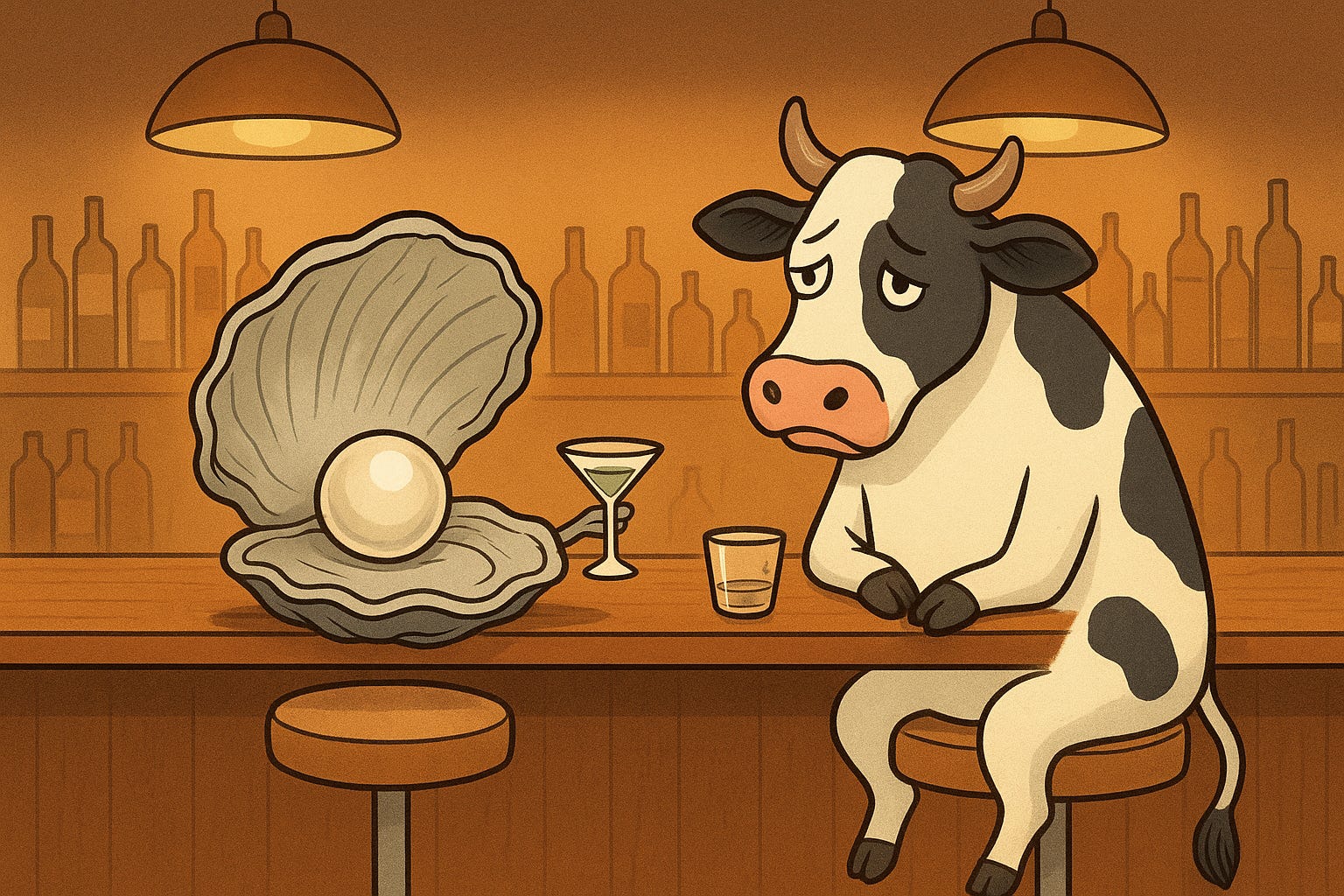
So when we see news about cultivated meat, insect protein for flour, and proteins from plants, what drives our resistance to try and adopt?
In my opinion, there are two critical points for each person to decide for themselves what drives this resistance: 1) is the alternative product functionally the same as the product you currently use and 2) if you could not perceive the difference between the products (appearance, flavor, aroma, nutritional value, allergenicity), would you still care enough to resist?
Obviously alternative proteins are not functionally the same as our beloved meats. The worst thing for alternative protein messaging has been the black bean burger. That depressingly bland, dry plant-based patty is not a burger. Alternative protein products can definitely lack in taste, texture, aroma, and nutritional value. So, that first question is generally easy to answer.
If the products were functionally the same, would you still care enough to resist?
For the second question, it’s tempting to imagine this scenario like some sort of puzzle. You are presented with two identical burgers, stacked to the ceiling with your favorite toppings, condiments, and seasonings, and you are tasked with determining whether these burgers are different from each other. But that’s not how we interact with food day-to-day.
If you went to the grocery store, walked to the meat section, purchased a lab-grown steak, cooked it to perfection, ate it, and felt satiated and energized, would you care enough to resist lab-grown meat technologies? Would the “fakeness” get to you?
(For my more grim readers: If 40 years after you ate the steak, you had the same heart attack that a lifetime of eating farm-grown steaks would have given you, would you care enough to resist?)
And while we discuss this question, the rest of the alternative protein industry will continue to make incremental changes to their plant-based burgers, cultivated steaks, mycoprotein not-chicken nuggets, and every other meat-oddity until we cannot tell the difference anymore.
Most importantly, this is NOT a crystal-ball-style prediction saying that 100% of our current meat products will be replaced by alternative protein technologies. I guarantee that will never be the case. But identifying affordable ways to produce these foods while maintaining the flavors, aromas, and nutritional benefits that we know and love will secure our food future during environmental, public health, and sociopolitical crises.
This is such an interesting subject - you’ve made a very thought-provoking comparison with cultured pearls and lab-created gemstones.